
There is quite a discussion in the body of Christ that is centered on faith. We have a lot of “faith healers” out there that say that if you pray over someone in faith that they are healed instantly, then that person will be instantly healed. I’m not here to question the validity of this belief in this blog, but I do want to enter the discussion about the role of faith and how it relates to patience and correction.
In the infamous verse in Hebrews 11, the author defines faith as “the substance of things hoped for, the evidence of things not seen.” From this, we can draw several conclusions.
Faith has substance. It is what you have when you look towards your dreams and goals, expecting to achieve them in the future, whether near or far off.
Faith is also evidence of what is unseen. God is not seen with the physical eye. Sure, we can marvel at His works in nature or His influence in our life’s direction, but He is not seen physically. Thus, FAITH IS THE EVIDENCE OF GOD.
Yet, we know from James 2:17 that faith without works is dead. Faith in God becomes evident when we constantly strive to follow after His will. Thus, our works prove our faith, which proves the existence of God.
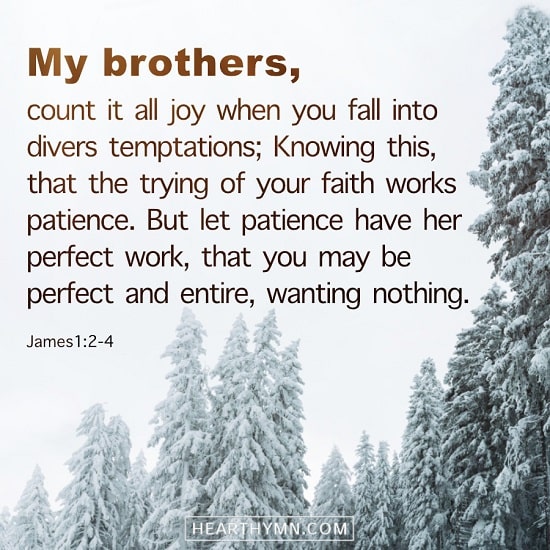
Tested Faith Builds Patience
For the past while, I’ve had James 1:4 as my wallpaper on my phone, which says, “Let patience have her perfect work, that you may be perfect and entire, lacking nothing.” There is a clause in the verses before this that draw the relationship between faith and patience. Here is James 1:2-4:
“My brethren, rejoice when you fall into diverse temptations: knowing this, that the trying of your faith works patience. But let patience have her perfect work, that you may be perfect and entire, lacking nothing.”
Thus, we see that when we are tested in our faith by the experiences of life, patience is built.
Exercising Faith through Patience
As of the writing of this blog, I have been feeling a little impatient when it comes to the promises of God in my life. This past Sunday, I heard a message preached that reminded me to be patient, and really solidified why James 1:4 is my current lock screen background.
Before I went to bed that night, I was began reading Hebrews, where I had left off previously, at the end of Chapter 10, and this is what inspired this message in this blog.
At the end of chapter 10, the author states: (I will be paraphrasing slightly from the KJV for the rest of this blog)
For you have need of patience, that you might receive the promises after you have done the will of God.”
This struck me hard. The reason that patience is so critical is because it will move us down the path of God’s will so that we can receive His promises. If we are constantly asking God to bring us our gifts now instead of when the time is right for us to receive them, we will lose patience and question the faithfulness of God on that particular promise we’ve been given.
A couple verses down from the one above, the writer quotes Habakkuk, saying, “The just shall live by faith,” after which he gives the definition of faith and presents several of those “just ones.”
At the end of chapter 11, the author gives a summary of all the things that they went through. The last part of verse 37 and all of 38 states that they were destitute, afflicted, and tormented, that they wandered in deserts, mountains, dens, and caves.
A question came to me as I read this part of the chapter: “Would you still be faithful in My promises even if you were brought to destitution or lived in caves?”
I thought of Elijah when he was living by the brook Kidron. Every day, the ravens would bring him food. He never had enough food to last for two meals. I asked myself, “Would I have that much faith, that I would trust God with every morsel of food that I ate?” It really put it into perspective that the trials that I am going through are not as tough as they seem.
My only answer to the question was this simple prayer: “Lord, increase my faith.”
Following the verses mentioned above, the writer goes on in chapter 12, giving some encouragement to the questions from above.
“Seeing as we are surrounded by so great a cloud of witnesses, let us lay aside everything that weighs us down, the sin that so easily ensnares us, and let us run with patience what is set before us, looking towards Christ, who is the author and perfector of faith.”
We are surrounded by a great cloud of witnesses that are saying, “Come on! You can do it! Keep pushing! You will win this race if you keep going!”
The key is to run with patience for the end. Life is a marathon. We must not give up so easily. We must also be attuned and trained so that we can run this race as best as we can. You cannot sprint a marathon. You will burn out. However, you can do a few sprinting bursts here and there – go faster at times and slower at others – resting if you need to – always having your eye on the promise – always having your eye fixed on Jesus Christ.
Correction: Not Always What You Think
The church my family used to go to taught that God is an angry Father, who would punish for every misstep. Once we stepped out of that church, I “threw the baby out with the bathwater.” I thought that God is a loving God who never punishes for wrong behavior, only gently guiding those back on path when they need it. I held an incomplete view of correction until I read Hebrews 12.
In verses 5 and 6, the author quotes Proverbs 3:11-12, saying, “My son, do not despise the chastening of the Lord and do not be discouraged when you are rebuked by Him. For those who the Lord loves, He chastens, and He scourges every son He receives.”

At that word “chastening,” in the center reference column in my Bible, it is translated as “discipline.” The verse in Proverbs that is being quoted uses the word “correction.”
Thus, we see that chasten, discipline, and correction do not always mean “punish.”
“Correction” literally means “to make correct.” If we are “correcting” behavior, it is not always necessary to use physical force or harsh words. Often only a few well-placed, well spoken, gentle words are needed for one to correct their behavior.
“Discipline” does not always mean “to punish” either. We do not say of someone who is working out in a gym that they are punishing themselves by working out. They are exercising – being put through trials to strengthen themselves.
Thus, when God disciplines us, it is to exercise our faith. Correction can come through severe hardships or pain, but that is not necessary all of the time. It is mostly saved for the direst of circumstances, and it will ALWAYS be for your benefit, as we shall see momentarily.
Hebrews 12 continues in verse 7 and the verses following:
“If you go through chastening,” (or correction, or discipline) “God the Father deals with you as a son, for what son is not corrected by his father?
“However, if you are without correction, of which all are partakers, then you are illegitimate sons, and not true sons.
“Furthermore, we have had fathers of your flesh which corrected us, and to whom we give much respect. Would it not be better to be subject to the Father of spirits and live? For they [our earthly fathers] chastened us as it seemed best to them. However, Abba chastens for OUR profit so that we might be partakers of His holiness.
“Now, no discipline seems pleasant at the time, but seems harsh. Yet, afterward it yields the peaceable fruit of righteousness to those who are exercised by it.”
Discipline yields the peaceable fruit of righteousness to those who use the discipline to become stronger. What is this fruit? From James 3:17-18, we know that the peaceable fruit of righteousness is wisdom.
Thus, discipline produces wisdom. To get wisdom, we must go through correction, either by experience or words of advice.
Abba Father does not punish His children through anger, but with love and in the perfect way that the child needs. We must listen to this correction or continue to be faced with it. If we do not correct our ways, we will continue to be disciplined until we learn to change.
The ancient Essenes taught that there are seven mirrors of relationships, and that every significant relationship that we have mirrors back to us something about ourselves. One of these mirrors states that our view of our parents mirrors to us our own view of God, our heavenly Father.
Our parents were sent to be a mirror to us as to the true nature of God. Whether they succeed in this or not, we often view God our heavenly Father in the same way that our physical parents portrayed themselves as parents.
Thus, we must also consistently strive to be the proper mirror to our children, so that they may see in us the true nature and character of the God we serve.
How does this relate to correction? If we discipline our children harshly or through anger, keeping stiff, rigid, limiting rules to never deviate from or else face severe punishment – that is how they will view God, as angry, rigid, and inflexible. If we use correction as a way of improving our children and guiding them towards the right path, instead of punishment for wrongdoings, that is how they will see the way that God deals with His children.
Conclusion
If we have great faith, we know that God has our back. He will protect us. Having great faith means engaging with Jehovah-Jireh – the Lord our provider. It is when we go through chastening from God that faith is built. Traveling the Refiner’s fire strengthens our patience. It shows us that we are to wait for His timing to act, even if it seems that we are ready for His promises right now.
One of the greatest gifts of the Spirit is discernment, not just of good and evil, but it is also of knowing when and where to act that best aligns with the will of God.
My friends, be strong. Be steadfast in the faith. Exercise patience. I cannot say when His gifts are to come, but what I do know is that if we walk closely with Him, He will show us what we are to do. Then, after we have walked in His will, He shall bring forth the reward.
 Super Success