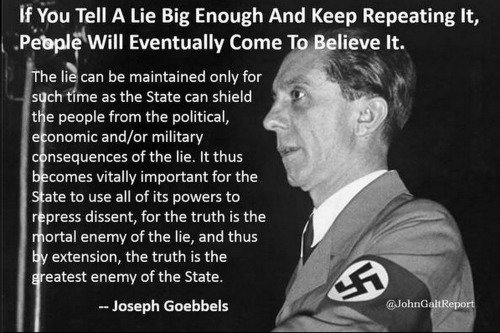
Read the pictured quote carefully.
Independence Day is a day of celebration as well as reflection and contemplation. Celebration that we can still have relative freedom. Reflection and contemplation for the “relative” part.
It is very evident for anyone with their eyes open that our world is becoming more and more chaotic. Many people are left wondering how we got to where we are. Even in my parent’s lifetime, the world has gone through a massive spiral downward. How did we get here? This article hopes to explain some of the answers. For the purposes of this conversation, we will start by going all the way back to 1666 with the Great Fire of London.
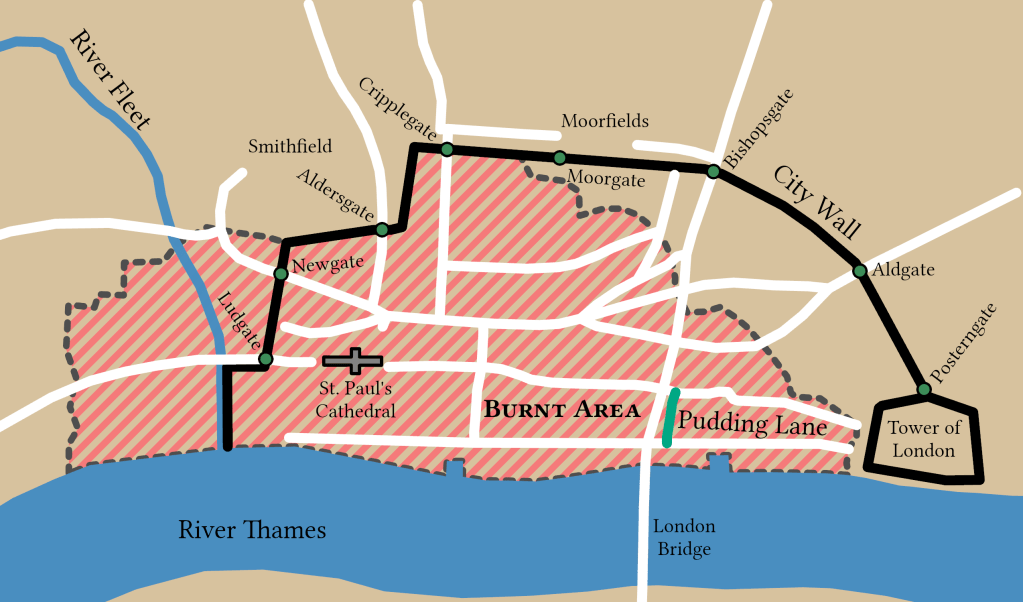
From September 2-6, 1666, a massive fire raged in central London, destroying the medieval City of London inside the old Roman city wall and extending to the west. In the end, more than 13,000 homes, churches, halls, and other buildings were destroyed, totaling more than 15% of the city’s housing destroyed and 9-10 million British pounds (1.8 billion pounds today) in property damage.1
This cleared-out section of land was used to build the modern City of London, resulting in the only parcel of land in the world that has no title deed. This small piece of land has its own laws, flag, defense, constitution, and police. This land is home to the Bank of England, the London Metal Exchange, Fleet Street, the FTSE Stock exchange, Royal Mind, and the Old Bailey Court House. This has led many to believe that the fire was intentionally started to clear out the land for the creation of the most influential ruling body in the world, though I have no way of proving this.
What is interesting, however, was the reaction to the fire. In an effort to find out who perished in the blaze, Parliament passed the Cestui Que Vie Act 1666. Cestui que vie is and old French word meaning “he who lives.” Black’s Law Dictionary defines it as “the person whose life measures the duration of a trust, gift, estate, or insurance contract.”2
What this did was it made all men, women, and children presumed and assumed dead, and a trust set up until they reclaimed the account. This effectively killed everyone, giving them 7 years to claim back their lives.
We will move on in history, past this event, but keep this event in mind as we move along.
Next we will jump ahead more than a century to the founding of the united States of America.
America’s Fight for Freedom
Contrary to popular belief, the 13 colonies did not split away from Great Britain solely for tax reasons. This was only one of the many reasons that the founding fathers listed in their documents. One of the other reasons stems from the Bank of England, the main private central bank of the time.
The Bank of England, just like many banks before and most banks since, practiced what is called “fractional-reserve banking.” Fractional reserve banking is perhaps as old as banking itself. Bankers discovered that only a fraction of people ever came in to claim their reserves. Thus, the banks discovered that they could lend more money than they had in reserve, making themselves more profitable. In today’s world, the banks can loan out up to ten times the amount that they have in reserves. If you deposit $1,000, for example, into your local bank, they are able to loan out $10,0003. If you or I do this, we can be arrested for fraud, but since it is a bank it is apparently okay.
This practice is especially dangerous when more people come to withdraw their money from their accounts than usual. The bank will not have enough stores in reserve to pay back all of them. Thus, people rush to their banks to withdraw their fair share, only for those banks to run out as well, and so on. When this becomes widespread, it leads to financial collapse. In fact, this was part of the cause of the 1929 crash that caused the Great Depression.
This process can also be artificially created – by those printing money restricting the amount printed each year or by more banks calling in loans. Both of these scenarios lead to the money supply of a country to become dried up, causing a depression.
On one of his trips to England, Benjamin Franklin was asked why the colonies were so prosperous. His reply was that the colonies printed their own debt-free currency, called “Colonial Script,” that was independent from the Bank of England. It was issued in proportion to the demands of trade and industry to make products pass more easily from producers to consumers. Upon hearing this, the English Parliament passed the Currency Act of 1764, strictly prohibiting the colonies to issue their own money, ordering that all taxes must be paid in gold and silver. Ben Franklin wrote in his autobiography, “In one year, the conditions were so reverse that the era of prosperity ended, and a depression set in, to such an extent that the streets of the Colonies were filled with unemployed.” According to Franklin, this was the main reason that fueled the American Revolution.
Before the Revolution, the money supply of America stood around $12 million.4 After the war this had ballooned to as much as $500 million, making their money nearly worthless. In 1781, Congress allowed the Financial Superintendent Robert Morris, along with others such as Alexander Hamilton, to open their own private central bank, christened the “Bank of North America.” This bank was closely modeled after the Bank of England. The value of American money continued to plummet, so the bank’s charter was not renewed in 1785.
In 1787, Congress held the Continental Congress. It was here that the Constitution for the United States of America was drafted and enacted.

Those such as George Washington and Thomas Jefferson were opposed to the idea of a central bank controlling the money supply of America. However, Gouverneur Morris, Robert Morris (both seen on the left5), Alexander Hamilton, and their cohorts convinced the other delegates to not give Congress the power to issue paper currency.
(Note: Congress DOES have the power to COIN currency. This is very different because it involves coining metals like gold and silver for use as currency.) Thus, the Constitution is silent on the matter.
In 1791, again at the behest of Alexander Hamilton, a new bank was chartered, called the “First Bank of the United States,” giving it a 20-year charter. Thomas Willing was the president of this bank, just as he had been the president of the Bank of North America. In the first 5 years of its existence, the government borrowed $6.2 million from the First Bank of the United States.6 In this same period, prices rose 72%. Thomas Jefferson lamented at the time, “I wish it were possible to obtain a single amendment to our Constitution… taking from the federal government their power of borrowing.”7 Many people feel the same way today.
In 1811, a bill was forwarded to the members of Congress to renew the charter for the First Bank of the United States. After a heated debate, Virginia and Pennsylvania demanded that Congress killed the bank. Even the press at the time criticized the bank’s existence. Yet, despite the outcry to kill the bank, there was opposition from those who would see it continue. Some even suggest that Nathan Rothschild threatened that war would come to America should the bank be absolved. However, the renewal bill was defeated by a single vote in the House and was deadlocked in the Senate. James Madison, President at the time, was a staunch opponent of the bank, and his Vice-President, George Clinton, broke the tie in the Senate, ending the bank’s existence.
In a matter of months, British troops were back on American soil, culminating in the War of 1812. Of all the wars in American history, this is probably the most obscure, perhaps because of its roots in the banking sphere. Since England was busy fighting Napoleon Bonaparte at the time, the war ended in a draw in 1814. However, this was far from the end of central banking in North America.
In 1816, Congress passed another bill creating yet another central bank, creatively named the “Second Bank of the United States.” The charter for this bank was virtually identical to the previous banks.
America’s Victory Over Central Banking
At this point, the people had about enough of the central banks. In 1828, Andrew “Old Hickory” Jackson, hero of the Battle of New Orleans during the War of 1812, was elected president. President Jackson was no advocate of the bank and wasted no time in attempting to shut it down. However, the end of the charter of the bank was not until 1836, the final year of his second term if he could last that long. During his first year as President, he fired nearly 1,000 government staff8 – roughly 10% of the total government staff at the time – who were compromised, paid out, etc. by the bank.
The bank fired back. In 1832, the year of Jackson’s reelection, they asked Congress to renew the bank’s charter 4 years early. Congress complied, yet President Jackson did not back down. He replied with his own veto statement on July 10, 1832, which is now considered one of the greatest documents of American history. In it, he states, “Controlling our currency, receiving our public moneys, and holding thousands of our citizens in dependence… would be more formidable and dangerous than a military power of the enemy.”9 In the end, Jackson won out, and Congress was not able to renew the bank in 1832.
For the first time, Jackson took his campaign on the road. Usually, a presidential candidate would stay at home and look proper and presidential. However, Jackson decided to go directly to the people. His campaign slogan was “Jackson and no bank.” The Republican Party at the time ran Senator Henry Clay against Jackson. Despite the banks dedicating $3 million to Clay, Jackson won by a landslide.
With his reelection secure, Jackson began in earnest to eradicate the bank. He fired 2 consecutive Secretary of Treasury appointees William Duane and Roger Taney, because they refused to begin transferring funds from the central bank to state banks.
Again, the banks lashed out, tightening the money supply in America and causing a financial crash and depression. In 1834, the Senate censured President Jackson. The media blamed Jackson, yet he stood firm. After a fortunate turn of events, which included Pennsylvania coming out in favor of Jackson and the bank’s head Nicholas Biddle being caught boasting about causing the financial crash, in April 1834, Congress voted against chartering the bank, and called for an investigation into the bank to see if it did indeed cause the financial collapse.
On January 8, 1835, Jackson paid off the final installment of the national debt. He was the ONLY president to ever pay of the national debt.
On January 30, 1835, just weeks after paying off the national debt, Richard Lawrence attempted to assassinate the President. By the grace of God, both pistols misfired. Lawrence was found “not guilty” by reason of insanity, though later boasted that powerful people in Europe put him up to the task and said that they would protect him from any danger.
When its charter ran out in 1836, the Second Bank of America ceased functioning. Biddle was arrested and tried for fraud. He was acquitted but died shortly thereafter.
When asked what his greatest accomplishment was during his presidency, President Jackson famously replied, “I killed the bank.” Indeed, he did it so effectively that it took over 75 years for it to be reinstated.
However, even though he had gotten rid of the international bankers in America, he failed to eradicate the root cause: fractional-reserve banking. There was some financial instability during the 1800’s, due to many of the state banks practicing fractional reserve banking, but this period generally marked a time of prosperity for America.
It was here that the bankers resorted to their old tactic: war to bankrupt the country.
The War of Northern Aggression
Just like any war in history, there were many factors that caused the Civil War. Northern industrialists used tariffs to make it more difficult for the South to purchase cheaper European goods. This caused Europe to halt cotton imports from the South. The South was now paying more for their basic essentials while earning less from their cotton exports.
Despite popular belief, slavery was not the primary cause of the Civil War. It was certainly a cause, but President Lincoln himself stated in his inaugural address one month before the war, “I have no purpose, directly or indirectly, to interfere with the institution of slavery in the States where it now exists. I believe I have no lawful right to do so, and I have no inclination to do so.”10
What’s more, the ceding of the Southern States that divided the nation was not entirely a natural process.
Otto von Bismarck, the man who united the German state a few years after the American Civil War, stated, “The division of the United States into federations of equal force was decided long before the Civil War by the high financial powers of Europe. These bankers were afraid that the United States… would attain economic and financial independence, which would upset their financial domination over the world.”11
Mere months after the first shots at Fort Sumter, France seized Mexico in order to take advantage of the war, to violate the Monroe Doctrine of 1823, to return Mexico over to colonial rule, and take control of Mexico’s vast silver deposits. A weakened America would not be able to prevent the re-colonization of Central and South America by Europe.
On November 8, 1861, the US Navy frigate USS San Jacinto discovered two Confederate envoys aboard the British Royal Navy’s RMS Trent on their way to Britain and France to lobby for financial and military support for the Confederate States. These two men, John Slidell of Louisiana and James Murray Mason of Virginia, and their two secretaries were promptly removed from the ship.
In the Union States, the response was universal praise for the capture of these men. However, England, who was ostensibly neutral in the conflict, did not appreciate America boarding one of her vessels.
In response to what is now known as the Trent Affair, Britain moved 11,000 troops to Canada, and the British fleet went onto war alert, both poised to strike should their quick intervention be called for.
America’s fate teetered on a knife’s edge. This is why President Lincoln fretted so much about the safety of the Union, which is why he talked more about union with, rather than the defeat of, the South. This was more than just a mere difference of opinion about slavery.
War, nevertheless, costs money. Needing money to finance the war, and not wishing to go to the bankers of New York for a loan, Lincoln went to his friend Colonel Dick Taylor. His reply was simple: just get Congress to pass a bill authorizing the printing of full legal tender treasury notes and pay the soldiers using them. In 1862-63, Lincoln printed $450 million worth of these treasury notes, all at 0% interest to the federal government. Nicknamed “greenbacks,” these were printed in green on the back side to distinguish from other bank notes at the time.
War is expensive, however. In 1863, with Northern and Southern troops positioned for the decisive battle of the Civil War and Congress needing more greenbacks to finance the war, Lincoln allowed the bankers to push through the National Bank Act, allowing these banks to operate under a tax-free status and to have a monopoly power to create the new form of money: bank notes. Greenbacks were still in circulation, but no more were printed.
More importantly than this, however, from this point forward, the entire money supply of America would be created out of debt by bankers buying US government bonds and in turn issuing them reserves for bank notes. Historian John Kenneth Galbraith explained, “In numerous years following the war, the Federal government ran a heavy surplus. It could not pay off its debt, retire its securities, because to do so meant there would be no bonds to back the national bank notes. To pay off the debt was to destroy the money supply.”12
Later in 1863, President Lincoln received unexpected aid from Czar Alexander II of Russia. Alexander II had refused a European-based national bank be set up in Russia, and should America survived, the Czar’s position would remain secure. If America was successfully split and put back under the power of the European banks, they would attempt to take down Russia as well. Thus, the Czar sent a portion of his fleet to port at New York and San Francisco, proclaiming that should either France or England give aid to the South, Russia would view it as an act of war.
Lincoln was reelected in 1864, and had he lived, he may well have destroyed the monopoly the bankers once again held in America. Like with Jackson before him, an attempt at assassination was had. Unlike with Jackson, however, the assassination was a success.13
After the assassination, Otto von Bismarck is said to have lamented, “The death of Lincoln was a disaster for Christendom. There was no man in the United States great enough to wear his boots… I fear that foreign bankers with their craftiness and tortuous tricks will entirely control the exuberant riches of America, and use it systematically to corrupt modern civilization. They will not hesitate to plunge the whole of Christendom into wars and chaos in order that the earth should become their inheritance.”14
With Lincoln gone, the banks strove to strengthen their hold in America. In a speech given to the Canadian Congress on May 2, 1934, which was reported on in The Vancouver Sun, Gerald G. McGeer stated that Lincoln was assassinated not only to reestablish an international bank in America, but it was also to get America back on the gold standard – gold they controlled. McGeer stated the following:
“Lincoln was the most powerful reformer of his day. Had he lived, he would have established a national currency system in the United States.
“There was only one group in the world at the time who could finance anything they cared to attempt without regard to cost, and who had any reason to desire the death of Lincoln.
“They were the men opposed to his national currency program, and who had fought him throughout the whole of the Civil War on his policy of greenback currency.
“They were the men interested in the establishment of the Gold Standard money system and the right of the bankers to manage the currency and credit of every nation in the world.
“With Lincoln out of the way, they were able to proceed with that plan, and did proceed with it in the United States. Within eight years after Lincoln’s assassination, silver was demonetized and the Gold Standard money system was set up in the United States.”15
The reason why the financiers of Europe chose gold rather than silver as the standard for global currency is because silver is far more plentiful in America. Gold has always been scarce globally, thus is far more easily monopolized.
With the market on gold sufficiently taken hold of, the multinational bankers set about to enslave the American people themselves.
The True Slavery of America
Our country started off as a constitutional republic, not a democracy. This is a very significant difference. In a constitutional republic, everyone – INCLUDING THE GOVERNMENT – is subject to the constitution of the country. Whereas, in a democracy the majority can simply vote to get rid of the constitution.
As I said above, our country started off as a constitutional republic. If you look at the Declaration of Independence, you can find the name of this republic: the “States of America.” In this document, “united” is not part of the name, just a simple adjective saying that the States united. This is extremely important as we consider the following.
In 1871, Congress passed the District of Columbia Organic Act of 1871, which established Washington D.C. as its own city-state – much like the Vatican and the City of London – and limited its authority to the ten square miles it was allocated. More importantly, it established the United States (note capitalization), or UNITED STATES, as a corporation. This can be found in Uniform Commercial Code (UCC) 9-307, which says, “The United States is located in the District of Colombia,”16 and 28 U.S. Code (USC) 3002 defines “United States” as “(A) a Federal corporation, (B) an agency, department, commission, board, or other entity of the United States, or (C) an instrumentality of the United States.”17
Here it is in plain English. The “United States” as referred to in any legal document of the United States refers to the Federal corporation located in Washington D.C, not the sovereign States of America who united beginning in 1776.
The CEO of this corporation, its president, sits in Washington D.C. The sovereign States of America and the corporation of the United States are two entirely separate entities. If you claim you are a citizen of the United States, you are claiming to be a resident of Washington D.C. and are therefore subject to whatever laws it passes. Ever since I learned this information, I have been very careful in my writing to distinguish between the two. Pay very close attention throughout the rest of this document to how I distinguish between the two.
Since its inception, the United States Corporation – WHICH EVERYONE THINKS IS THE COUNTRY FOUND IN 1776 – has been the front duping the American national sovereign people into its corporate system. The UNITED STATES is the de facto government, while the States of America is the de jure government.
We will revisit this topic in a moment.
The Creature Returns
In November 1910, a group of six of the most powerful financiers in America – Nelson Aldrich, A. Piatt Andrew, Henry Davison, Arthur Shelton, Frank Vanderlip and Paul Warburg – met at the Jekyll Island Club, off the coast of Georgia, to write a plan to reform the nation’s banking system. The meeting and its purpose were closely guarded secrets, and participants did not admit that the meeting occurred until the 1930s. So secret was their meeting that they each traveled under their first names only and arrived separately.
By the end of their time on Jekyll Island, Aldrich and his colleagues had developed a plan for a Reserve Association of America, a single central bank with fifteen branches across the country. Shortly after returning home, Aldrich became ill and was unable to write the group’s final report. So, Vanderlip and Strong traveled to Washington to get the plan ready for Congress. Aldrich presented it to the National Monetary Commission in January 1911 without telling the commission members how the plan had been developed. A final report, along with legislative text, went to Congress a year later with a few minor changes, including naming the new institution the National Reserve Association.
However, many people, especially Democrats, objected to the version of democracy it presented, which could have allowed the largest banks to exert outsized influence on the central bank’s leadership. With a presidential election coming up, the Democrats made repudiating the Aldrich plan a part of their platform. When Woodrow Wilson won the presidency and the Democrats took control of both houses, Aldrich’s National Reserve Association appeared to be shelved.
Leaders of the Democratic Party, however, also were interested in reform, including President Wilson and the chairs of the House and Senate Committees on Banking and Currency, Carter Glass and Robert Owen, respectively. Wilson’s chief political adviser, Col. Edward Mandell House, met and corresponded with Warburg to discuss banking reform in general and the Glass and Owen plans in particular, as did William McAdoo and Henry Morgenthau, senior political and policy advisers to Wilson who served in his administration.
Together, these ideas formed the basis of the final Federal Reserve Act, which Congress passed and the president signed in December 1913. The technical details of the final bill closely resembled those of the Aldrich Plan.18
In the years leading up to its passing, several financial panics were incited with the help of bankers such as J. P. Morgan. What the Federal Reserve did was handed control of our nation’s monetary supply out of the hands of Congress, or to put it differently, the hands of the people, and into the jaws of a private corporation headed by supranational bankers like the Rockefellers, Morgans, and Rothschilds. It is no more federal than the Federal Express and has little in regards to reserves.
What the Federal Reserve does is it prints currency, loans it to the government, then charges interest on the currency it loaned. This constitutes the vast majority of our country’s debt.
During the Civil War, as you remember, President Lincoln printed “greenbacks.” This was a Constitutional way for printing the money because it was passed through Congress, and it had no interest attached to it to pay off later.
What the Federal Reserve does is it literally prints currency out of NOTHING, not even having any gold, silver, or precious metals to back it up. This is what has caused the massive inflation that our country has seen since the Federal Reserve was founded. From the time the Pilgrims landed to 1913 there was almost zero net inflation. There was inflation during the wars that the country faced during different periods, but the money was always stabilized afterward. After 1913, and during and immediately after WW1, inflation increased dramatically. The Great Depression caused a deflation, but the onset of WW2 caused an inflation that has never subsided and has never stopped.
The Federal Reserve was used to help fund the United States during WW1. After WW1, the United States Corporation was becoming bankrupt. So in 1929, the Great Depression was deliberately fabricated so that the populous would not suspect anything was wrong as well as to get their minds off of how they were fooled into fighting WW1. Winston Churchill was even flown in to witness the Stock Market crash.
President Franklin D. Roosevelt’s administration did two major things to further enslave the American people by selling his “New Deal” to the public. First, he called in the gold and silver in 1933 and replaced it permanently with paper (“because gold and silver is heavy and wears holes in your pockets” was the pretext). In doing so he robbed the people of real, lawful money and replaced it with useless paper. As a matter of fact, the Trading with the Enemy Act was amended to include citizens of the United States if they owned gold. This ban on gold ownership was later lifted by congressional amendment, as gold was no longer used to back the Federal Reserve notes.
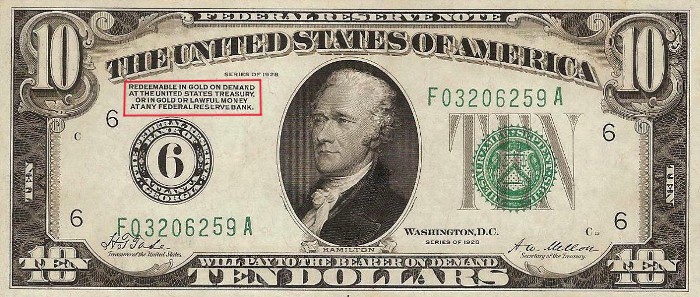
Before this time you could trade your paper currency for gold or silver money. In fact, as you see above on the $10 bill from 192819, it says (highlighted in red), “Redeemable in gold on demand at any United States treasury or in gold or lawful money at any Federal Reserve bank.” There is a very interesting thing about this statement: “redeemable in… lawful money.” A thinking person could legitimately ask, “Wait, if this is saying I can trade it in for lawful money, is this saying that this paper is not lawful money?”

After Roosevelt called in the gold, you could no longer trade your paper for gold at a bank. The bills printed during and immediately after this (as seen above20) said, “This note is legal tender for all debts, public and private, and is redeemable in lawful money at the United States treasury or at any Federal Reserve bank.” Notice: it still says you can trade it in for “lawful money,” and it no longer says that you can trade it in for gold. If you look at any dollar bill printed today it only says, “This note is legal tender for all debts, public and private.”
What on earth is legal tender, and how is it different from lawful money?
According to the Merriam-Webster Dictionary, “lawful money” is “any money whether coin or currency that may by the laws of a country be circulated as a medium of exchange.”21 Whereas, “legal tender” is defined as “money that is legally valid for the payment of debts and that must be accepted for that purpose when offered.”22
Here, you see the difference. Lawful money can be anything that represents a certain amount of valuable currency, and it can be used as a medium of exchange between two parties. On the other hand, legal tender is the only legally valid form of payment to pay off debts.
Before 1933, there was very little “legal tender” in circulation in the United States. Up until the Federal Reserve Act of 1913, the only currency issued by the United States that was legally recognized as “lawful money” was precious metals (gold and silver coins for instance), “demand notes” (essentially paper money given in exchange for gold and silver coins that could be reclaimed at any time), and the “greenbacks” authorized by Congress. Still, the Federal Reserve Act did not define the term “lawful money,” which has led to the confusion of terms.
Under Roosevelt, Congress changed the law so that all US coins and currency (including Federal Reserve notes) constitutes as “legal tender.” Federal and State courts have also held that Federal Reserve notes do constitute as “lawful money.”23
Finally, 31 USC 5103 defines “legal tender” as “United States coins and currency (including Federal reserve notes and circulating notes of Federal reserve banks and national banks) are legal tender for all debts, public charges, taxes, and dues. Foreign gold or silver coins are not legal tender for debts.”24
First, notice that legal tender only applies to the corporate United States, not to the de jure States.
Second, notice the statement about “foreign” gold and silver coins.
Black’s Law Dictionary, 4th Edition, defines “foreign” as “Belonging to another nation or country; belonging or attached to another jurisdiction.”25
Therefore, gold and silver coins (you know, the things that were among the highest standard of trade for millennia) that are not owned by the United States cannot legally be used for any debt or public trade.
In reality, true, and lawful money is something that has or represents value. The paper money printed before the New Deal, and certainly before the Federal Reserve Act, was lawful money, because it represented the corresponding amount of precious metal.
Our current fiat currency is backed by nothing. Therefore, it has no inherent value other that what the government says it has, and we are just supposed to trust what they say.
The Nature of a Person is a Corporation
The second thing the Roosevelt Administration did was give all those who were willing a social security number. This created what is known as a “straw man” (after the Straw Man in the Wizard of Oz, which HAS NO BRAIN). Your straw man is a fictitious, artificial “person”/corporation the government made in your name and does business through. Your straw man can be identified easily because the name is in all capital letters (example: AUSTIN DEN HOED).
Recall the Great Fire of London in 1666. Remember how they created a trust in the place of those affected by the fire? This is what the US government does when you get a birth certificate.
One way that they are able to do this is using the law of the sea.
There are two different kinds of laws in the world: those based on the law of the land, know as Common Law or Natural Law, and those based on the law of the sea, known as Maritime Law or Admiralty Law. Common Law preserves the inalienable rights of those on land. Maritime Law grants rights that are legal to conduct merchant, banking, corporate, and international commerce. Common Law defines what is lawful. Maritime law defines what is legal to conduct commerce and transcends international boundaries legally.
You may say, “Well, I live on land. Therefore, Admiralty Law does not apply to me.” This is where you are incorrect. The “powers that shouldn’t be” have manipulated Admiralty Law to include those on land. Here’s how.
Ships traverse water. All ships are referred to as female. Thus, a woman is a ship. The man is a fabricator. Man delivers the “seamen” to the woman, the “vessel,” who carries this “live stock” for 9 months. At the end of the 9 months, the woman’s water breaks, and she goes to a hospital to give “birth.”
When a ship comes to dock, it is tied off at “berth.” The captain submits a “manifest of berth” for the ship. This manifest is a list of items that are being “delivered.” The dock master signs the manifest claiming the shipment, including all “live stock,” as property of the “ward.”
When a woman arrives at the hospital “ward,” the woman “delivers” the “live stock” through “labor.” The dock master, the “doc”-tor, will untie the cargo from the ship by cutting the umbilical cord. By signing the “certificate of live birth,” the parents are informing the doctor that the stock has been delivered and can be claimed by signature. The doctor signs the certificate, making you property of the ward and making you lost at sea as unclaimed corporate property.26
In your “absence,” the US government created a fictitious legal person to represent you in all of their commerce. As stated earlier, this “straw man” is denoted by all capital letters. I found it interesting to note that in the Style Manual for the US government it says, “Names of vessels are quoted in matter printed in other than capitals and lowercase roman, even if there is italic type available in the series.”27 What this means is that all vessels should be printed in all capital letters. Look at the name plates of most US and British ships. They are in all capital letters. Recall, also, the above-mentioned correlation between ship vessels and human vessels.
You have tied yourself to this “straw man” in many ways: birth certificate, driver’s license, marriage license, income tax, hunting license, W-4 forms, etc. What most people do not realize is that being tied to this corporation keeps them in bondage. Remember when I said that the head of the United States Corporation is in Washington D.C? Well, your straw man also resides in Washington D.C. Your straw man is a citizen of the United States and must obey the laws of the United States, and if you have tied yourself to it, you must obey as well. There are a few ways to get out of and untether yourself from the system, but you must educate yourself on how to live outside the system, otherwise you will be sucked right back in.
At this point, some of you may still not be convinced. You may rightfully question, “All this talk about the twisting of the English language is nothing more than conjecture and coincidence. Do you have legal proof that ‘US citizen’ is a corporate entity? What gives the Federal government the power to create these corporations in the first place?”
We must continue with some more legal definitions. Then I will conclude with a little more history.
We must begin with the definition of “person.” When describing your “straw man,” I mentioned that it was a fictitious, artificial “person.” If you have ever looked at any legal document, it almost exclusively refers to men and women as “person,” “persons,” or “citizens.” The definitions of these words are vital to this conversation.
In 26 US Code 7701 (a), it defines “person” as “shall be construed to mean and include an individual, a trust, estate, partnership, association, company, or corporation.”28
Furthermore, Black’s Law Dictionary states that there are two kinds of “persons,” natural and artificial:
“A natural person is a human being. Artificial persons include a collection or succession of natural persons forming a corporation.”29
Thus, your “straw man” could be referred to as an ens legis, defined by Black’s Law Dictionary as “an artificial being, as contrasted with a natural person; applied to corporations, considered as deriving their existence entirely from the law.”30
I am not a “person” or “citizen” in any legal sense. Regardless of what Black’s Law Dictionary states, I don’t even like to refer to myself as a “natural person” or “individual,” because those definitions can be too easily misconstrued. Rather, I am a human. My ens legis is a person and citizen.
Speaking of which, what about that word “citizen?” What does it mean? Black’s Law Dictionary has some VERY interesting things to say about it.
According to the 5th Edition, “‘Citizens’ are members of a political community who, in their associated capacity, have established or submitted themselves to the dominion of a government for the promotion of their general welfare and protection of their individual as well as collective rights.”31
This is fascinating enough. This means that, since the United States is its own entity as separate from the United States of America, if you claim to be a US citizen, you claim to be a member of this corporation, and must submit to whatever rules and regulations they pass, whether they are Constitutional or not.
However, the definition gets even more fascinating when you look at the 4th Edition of Black’s Law Dictionary. As one of its definitions, it says:
“A corporation is a citizen of state under whose laws it is created and a nonresident of every other state… It is not a citizen within meaning of federal constitution declaring citizens of each state entitled to privileges and immunities of citizens in the several states or within Fourteenth Amendment prohibiting states from abridging privileges and immunities of citizens of United States.”32
Again, we see a tie between “citizen” and “corporation.” However, notice this definition takes it one step further.
Not only must the persons and citizens of the United States obey the rules of this corporation, because they themselves are corporations via the connections to their ens legis, they are not entitled to the privileges and immunities granted in the federal constitution, nor are they entitled to the right prohibiting states from infringing these privileges.
The Last Straw
Yet, one question remains: What gives the Federal government the right to create these corporations, over which they are able to exert such totalitarian control?
The answer is very simple, and we must turn to what Supreme Court Justice Samuel Miller said during The Slaughter-House Cases brought before the Supreme Court in 1873. Remember that this is only a mere two years after the passing of the District of Columbia Organic Act of 1871.
At the time, New Orleans, LA, was suffering issues surrounding the slaughterhouse industry. Up-river of the city, butchers slaughtered hundreds of thousands of animals per year, dumping all of the waste materials from these animals into the Mississippi River, which flowed right through the city causing a number of disease outbreaks.
To solve this problem, the Louisiana legislature passed an act to incorporate the slaughterhouse industry in the area so that it could better regulate the disposal of the animal entrails. Members of the Butchers’ Benevolent Association challenged the constitutionality of the corporation, claiming that it violated the Fourteenth Amendment.
What did the Supreme Court rule on this case? It was Justice Miller who wrote the majority opinion, which ruled in favor of the slaughterhouse corporation and upheld the constitutionality of Louisiana’s use of its policing power to regulate the industry. Aside what was mentioned before, this case would change the course of the United States of America, and nobody knows about it.
Justice Miller said, “That wherever a legislature has the right to accomplish a certain result, and that result is best attained by means of a corporation, it has the right to create such a corporation, and to endow it with the powers necessary to effect the desired and lawful purposes…”33
In other words, ANY legislature of the government has the power to create ANY corporation they wish and to give it as much or little power they wish. These corporations then become the working arm of the government, as stated in the definition of “corporation” in Black’s Law Dictionary, 4th Edition:
“A public corporation is one created by the state for political purposes and to act as an agency in the administration of civil government”34
This is opposed to “private corporations,” which are “those founded by and composed of private individuals, for private purposes, as distinguished from governmental purposes, and having no political or governmental franchises or duties.”
Let’s finish by taking a close look at the 14th Amendment, as this will be the final nail in the coffin in the entire person/citizen vs. man/human idea.
For those who need a refresher, the 14th Amendment did the following:
- It granted citizenship to all persons “born or naturalized in the United States,” and provided all citizens with “equal protection under the laws,” extending the provisions of the Bill or Rights to the states.
- It authorized the government to punish states that abridged citizens’ right to vote by proportionally reducing their representation in Congress.
- It banned those who “engaged in insurrection” against the United States from holding any civil, military, or elected office without the approval of 2/3 of both the House and Senate
- It prohibited former Confederate states from repaying war debts and compensating former slave owners for the emancipation of their slaves.
- It granted Congress the power to enforce this amendment.
This Amendment followed directly from aftermath of the American Civil War. Before the freeing of the slaves in America, they were not considered citizens of the States that their owners resided in. They were simply property under their owners and had no rights. After the war and the slaves were freed, there came an issue of how to integrate all these people into society.
It must be noted that at the time, the 14th Amendment was not a terrible idea. The government was trying to reorganize the turmoil between the North and South as to how the “Negroes” were to be released from slavery. The North was opposed to slavery, of course, and the South didn’t want the released slaves to have the same rights as the rest of the “state citizens.” The compromise was the creation of the “Federal citizen” or “US citizen” category to accommodate these individuals.
Again, to quote Justice Miller, “…all the negro race who had recently been made freemen, were still, not only not citizens, but were incapable of becoming so by anything short of an amendment to the Constitution. To remove this difficulty primarily, and to establish a clear and comprehensive definition of citizenship which should declare what should constitute citizenship of the United States, and also the citizenship of a State, the first clause of the first section was framed.”35
Keep this bolded part in mind, as it will be incredibly important later.
Another case from the California Supreme Court stated:
“The history and aim of the Fourteenth Amendment is well known… That purpose was to confer the status of citizenship upon a numerous class of persons domiciled within the limits of the United States, who could not be brought within the operation of the naturalization laws because native born, and whose birth… had at the same time left them without the status of citizenship. These persons were not white persons, but were… persons of African descent, who had been held in slavery in this country, or… were the native-born descendants of slaves. Prior to the adoption of the Fourteenth Amendment it was settled that neither slaves, nor those who had been such, nor the descendants of these… were capable of becoming citizens of the United States. (Dred Scott v. Sanford, 19 How. 393.) The Thirteenth Amendment, though conferring the boon of freedom upon native-born persons of African blood, had yet left them under an insuperable bar as to citizenship; and it was mainly to remedy this condition that the Fourteenth Amendment was adopted.”36
Thus, for the first time, there came about a distinction between “State citizen” and “US citizen.” Before this, people were classified by the state they lived in (“Iowan,” “Texan,” “Virginian,” etc.).
This is no more clearly explained than in the Slaughter-House Cases, as seen from Justice Miller below.37
“The first section of the fourteenth article, to which our attention is more specially invited, opens with a definition of citizenship — not only citizenship of the United States, but citizenship of the States. No such definition was previously found in the Constitution, nor had any attempt been made to define it by act of Congress… It had been said by eminent judges that no man was a citizen of the United States, except as he was a citizen of one of the States composing the Union. Those, therefore, who had been born and resided always in the District of Columbia or in the Territories, though within the United States, were not citizens.”38
Even the Wikipedia page draws this conclusion: “The Slaughter-House Cases, 83 U.S. (16 Wall.) 36 (1873), was a landmark U.S. Supreme Court decision which ruled that the Privileges or Immunities Clause of the Fourteenth Amendment to the U.S. Constitution only protects the legal rights that are associated with federal U.S. citizenship, not those that pertain to state citizenship.”39
The 1940 Madden vs. Kentucky Supreme Court case also ruled the following:
“…the privileges and immunities clause protects all citizens against abridgment by states of rights of national citizenship as distinct from the fundamental or natural rights inherent in state citizenship. This Court declared in the Slaughter-House Cases that the Fourteenth Amendment as well as the Thirteenth and Fifteenth were adopted to protect the Negroes in their freedom. This almost contemporaneous interpretation extended the benefits of the privileges and immunities clause to other rights which are inherent in national citizenship but denied it to those which spring from state citizenship.”40
Hopefully, you see by now that there is indeed a distinct difference between “US citizenship” and “State citizenship,” that the United States is a corporation. If you claim that you are a citizen of the United States then you are claiming to be a member of this corporation. This corporation has created a fictitious legal person who must abide by their rules. By signing under penalty of perjury on any relevant legal document that this person is you (driver’s license, tax forms, etc.) you are also claiming to be a citizen of the United States. By claiming to be such, you are subject to their rules.
This final statement – “by claiming you are a thing, then you are a thing” – is what is known as “naturalization.” An example would be in the Section 1 of the 14th Amendment:
“All persons born or naturalized in the United States, and subject to the jurisdiction thereof, are citizens of the United States and of the State wherein they reside.”
What is the definition of “naturalization”? We can find it in 8 US Code 1101 (a) (23), which says:
“The term ‘naturalization’ means the conferring of nationality of a state upon a person after birth by any means whatsoever.”41
This is how by simply signing under penalty of perjury that you are a US Citizen on something as simple as a W4 form for your job, you have tied yourself to the corporation, and by claiming, “Yes, this ens legis ‘straw man’ is me,” you have further entangled yourself in its web.
However, what if I told you that THERE IS NO SUCH THING AS A US CITIZEN? The very foundation that brought this class of citizenship is ENTIRELY BUILT ON A FARCE!!! According Congressional Records, the 14th Amendment was never constitutionally ratified into the Bill of Rights.
The Congressional Records from June 13, 1967, says:42
“We have tolerantly permitted the habitual misuse of words to serve as a vehicle to abandon our foundations and goals. Thus, the present use and expansion of the 14th amendment is a sham serving as a crutch and hoodwink to precipitate a quasi-legal approach for overthrow of the tender balances and protections of limitation found in the Constitution.”
Furthermore, these records state:
“The purported 14th Amendment of the United States Constitution is and should be held ineffective, invalid, null, void, and unconstitutional for the following reasons:
“1. The Joint Resolution proposing said Amendment was not submitted to or adopted by a Constitutional Congress.
“2. The Joint Resolution was not submitted to the President for his approval.
“3. The proposed 14th Amendment was rejected by more than one-fourth of all states then in the Union, and it was never ratified by three-fourths of all the States in the Union.”
As these documents show, 15 of the then 37 States rejected the proposed 14th Amendment, thereby nullifying it and making it impossible for its ratification.
A question then arises. How on earth did this amendment become a part of the Constitution if not enough of the required States ratified it? These Congressional Records also answer this question:
“The Reconstruction Acts of Congress unlawfully overthrew their existing governments, removed their lawfully constituted legislatures by military force, and replaced them with rump legislatures which carried out military orders and pretended to ratify the 14th Amendment…
“In spite of the fact that the Secretary of State in his first proclamation, on July 20, 1868, expressed doubt as to whether three-fourths of the required states had ratified the 14th Amendment, Congress nevertheless adopted a resolution on July 28, 1868, unlawfully declaring that three-fourths of the states had ratified the 14th Amendment…”
What does all of this mean? As was ruled in the Slaughter-House Cases, the 14th Amendment created the US Citizen category.
However, since the 14th Amendment was never constitutionally ratified, there is legally and constitutionally no such thing as a United States Citizen! Since the “US Citizen” class does not exist – the entire foundation of the corporate United States system, its laws, policies, statues, and agencies – the entirety of the corporate United States system has ZERO legal or constitutional foundation and, therefore, does not exist.
Every single one of the three-letter agencies created by the United States are unlawful and unconstitutional, because they are upheld by something that is a complete farce that does not exist. The “laws” and “statutes” created by the United States that these agencies are designed to enforce have no constitutional foundation, and therefore, the people of America have no obligation to abide by them.
Only those who swear under penalty of perjury that they are US Citizens must obey these policies, that is until they release themselves from these contracts.
If all of this is true, what about all of the contracts and documents we sign verifying under penalty of perjury that we are US Citizens?
According to 18 US Code 911, “Whoever falsely and willfully represents himself to be a citizen of the United States shall be fined under this title or imprisoned not more than three years, or both.”43
Therefore, since no one is a US Citizen because such a thing does not exist, if they knowingly, willfully, and falsely represents himself as such, they WILL BE fined, imprisoned, or both.
The key word here is “willfully.” Since we were completely in the dark about this information when we first signed those documents, this does not yet affect us. However, now that we know this information, once we free ourselves from these contracts, we will no longer be able to rightfully claim that we are US Citizens. Our ens legis will still be considered as such, but it will be recognized that this “person” is different from us as humans.
How do we break free of these contracts? That is a topic for another time. For now, I will point you to a fantastic course by one Brandon Joe Williams called “Contract Killer Course.” I will have it listed at the end for you to check out.44
Conclusion
You have power over what you create. God created man; therefore, He has authority to subject man to his will. Man created government; therefore, all leaders are public servants to act according to the will of the people, and they only have as much authority as we allow for them to have. Government creates corporations, including your straw man and 501(c)3 churches; therefore, government has the right and power to regulate and administrate them. By tying yourself to your straw man, you are putting yourself from being directly under God to being at the bottom of the “food chain” under the government.
Since the United States was founded, those in power (not necessarily those that are in the elected public office) are trying to keep you in their corporation. They have been duping people into thinking that the States of America in the Declaration of Independence and the United States Corporation founded in the 1870’s are the same. THEY ARE NOT. The reason why the government can put the citizens of the United States on lockdown and censorship during a crisis they created (I’m not just talking COVID-19, but also the World Wars, Korea, Vietnam, etc.) is because they have power over the straw men they created which the people have tied themselves to.
But there is good news. As Goebbels said, the lie can be maintained as long as the people don’t educate themselves. That is exactly what people are doing across the States. They are educating themselves and opposing the system. This can only have its maximum effect if we are outside of the system we are trying to oppose. Until we cut our ties to the system they have power to shut us down.
Educate yourself. Again, as Goebbels said, the TRUTH is the enemy of the state. No matter how cleverly spun the lie may be, it must always yield to the light of the truth.
Footnotes:
- Map and stats of the 1666 Great Fire of London:
https://en.wikipedia.org/wiki/Great_Fire_of_London ↩︎ - Definition of “cestui que vie“
Black’s Law Dictionary, Revised 4th Edition. St. Paul, MN: West Publishing Co, 1968, p. 289 ↩︎ - One source talking about fractional reserve banking:
https://www.nerdwallet.com/article/banking/fractional-reserve-banking ↩︎ - Approximate total of the money supply in America before Revolutionary War:
https://eh.net/encyclopedia/money-in-the-american-colonies/ ↩︎ - Photo of Gouverneur Morris and Robert Morris:
https://en.wikipedia.org/wiki/Robert_Morris_(financier) ↩︎ - Total amount borrowed from the First Bank of the United States:
John Thom Holdsworth and Davis R. Dewey, The First and Second Banks of the United States. Washington, D.C.: Government Printing Office, 1910, p. 45
https://archive.org/details/firstsecondbanks00hold ↩︎ - Quote from Thomas Jefferson to John Taylor, November 26, 1798
https://founders.archives.gov/documents/Jefferson/01-30-02-0398 ↩︎ - Howe, Daniel W. (2007). What hath God Wrought, The Transformation of America, 1815-1848. Oxford University Press, Inc, p. 333 ↩︎
- President Jackson’s July 10, 1832, veto message from the Library of Congress:
https://www.loc.gov/resource/rbpe.19403000/?st=text ↩︎ - President Lincoln’s March 4, 1861, first inaugural address from the Library of Congress:
https://www.loc.gov/resource/mal.0773800/?st=text&r=-0.078,0,1.156,1.511,0 ↩︎ - The authenticity of this quote is somewhat dubious. The quote first appeared in the French magazine La Vieille France, No. 216, March 17-24, 1921, and was written by a German-American named Conrad Siem, who also wrote on the life and views of Bismarck. He claimed that Bismarck wrote this to him in a letter in 1876, when he would have been 15 years old and living in America. For more details, see the link below.
Regardless of the authenticity of the quote itself, the concept is most certainly correct.
https://www.garynorth.com/public/6940.cfm ↩︎ - Galbraith, John K. (1975). Money, Whence it Came, Where it Went. Boston: Houghton Mifflin, p. 90 ↩︎
- For a brilliant exposé on the conspiracy to assassinate President Lincoln, I would highly suggest the book written by James Perloff called Exploding the Official Myths of the Lincoln Assassination. A summary conversation about the book can be viewed in the following podcast:
“James Perloff on Myths of the Lincoln Assassination”
https://www.google.com/url?sa=t&source=web&rct=j&opi=89978449&url=https://www.podomatic.com/podcasts/tkelly6785757/episodes/2024-07-24T20_35_41-07_00&ved=2ahUKEwiOx5_iqtuMAxURkYkEHSnKCWcQFnoECBcQAQ&usg=AOvVaw2TR95APB5MCsH_D_bZYd4H ↩︎ - This is another quote that Conrad Siem claims to have received from Bismarck himself. As with the previous quote, its authenticity may be taken with a grain of salt. Once again, however, the concept behind the quote is most certainly correct. Following is the source of the quote:
“The C.S.L.T.: containing views on Abraham Lincoln as expressed by Bismarck in 1878, from the recollections of Conrad von Bauditz Siem”. Book by Conrad von Bauditz Siem, 1915. ↩︎ - This quote can be found in the May 2, 1934, edition of The Vancouver Sun on page 11. The article is entitled “McGeer’s 4-Point Plan” and was written by T. I. Bullock. Link to a photocopy of the article is below:
https://www.newspapers.com/image/490558751/?match=1&terms=gold%20standard ↩︎ - UCC 9-307, subsection (h), Cornell Law School
https://www.law.cornell.edu/ucc/9/9-307 ↩︎ - 28 US Code 3002, subsection (15), Cornell Law School
https://www.law.cornell.edu/uscode/text/28/3002 ↩︎ - Info on the Federal Reserve comes from the official website on the history of the Federal Reserve:
https://www.federalreservehistory.org/essays/jekyll-island-conference. ↩︎ - $10 bill image source link:
https://www.silverrecyclers.com/blog/1928-10-dollar-bill.aspx ↩︎ - 1950 $5 bill image source link (the article is also worth the read):
https://dailyreckoning.com/the-governments-greatest-con-job/ ↩︎ - Definition of “lawful money,” Merriam-Webster Dictionary
https://www.merriam-webster.com/dictionary/lawful%20money ↩︎ - Definition of “legal tender,” Merriam-Webster Dictionary
https://www.merriam-webster.com/dictionary/legal%20tender ↩︎ - This and the proceeding paragraph are from the following website:
https://www.federalreserve.gov/faqs/money_15197.htm ↩︎ - 31 US Code 5103, Cornell Law School
https://www.law.cornell.edu/uscode/text/31/5103 ↩︎ - Definition of “foreign”
Black, Henry Campbell, M. A. Black’s Law Dictionary, Revised 4th Edition. St. Paul, MN: West Publishing Co, 1968, p. 775 ↩︎ - This very interesting comparison of language comes from one of the “Additional Resources for Your Study” at the end of this article.
“Dead in the Water – Maritime Admiralty UCC” ↩︎ - Style Manual: An official guide to the form and style of Federal Government publishing, 2016, Section 11.7
https://www.google.com/url?sa=t&source=web&rct=j&opi=89978449&url=https://www.govinfo.gov/content/pkg/GPO-STYLEMANUAL-2016/pdf/GPO-STYLEMANUAL-2016.pdf&ved=2ahUKEwim8ZPc492MAxUvlYkEHYnICUYQFnoECA8QAQ&usg=AOvVaw2CLV4QhXhUHNZnxf67AndK ↩︎ - 26 US Code 7701 – Definitions
https://www.law.cornell.edu/uscode/text/26/7701 ↩︎ - Definition of “person”
Black, Henry Campbell, M. A. Black’s Law Dictionary, Revised 4th Edition. St. Paul, MN: West Publishing Co, 1968, p. 1299-1300 ↩︎ - Definition of “ens legis“
Black, Henry Campbell, M. A. Black’s Law Dictionary, Revised 4th Edition. St. Paul, MN: West Publishing Co, 1968, p. 624 ↩︎ - Definition of “citizen”
Black, Henry Campbell, M. A. Black’s Law Dictionary, Fifth Edition. St. Paul, MN: West Publishing Co, 1979, p. 221-222 ↩︎ - Definition of “citizen”
Black, Henry Campbell, M. A. Black’s Law Dictionary, Revised 4th Edition. St. Paul, MN: West Publishing Co, 1968, p. 310-311 ↩︎ - Slaughter-House Cases, 83 U.S. (16 Wall.) 36 (1873), p. 64
https://www.google.com/url?sa=t&source=web&rct=j&opi=89978449&url=https://tile.loc.gov/storage-services/service/ll/usrep/usrep083/usrep083036/usrep083036.pdf&ved=2ahUKEwislc3N6t2MAxXKg4kEHUyYL9MQFnoECBsQAQ&usg=AOvVaw3EK8Dvn9m6YBhlHI-l6G1E ↩︎ - Definition of “corporation”
Black, Henry Campbell, M. A. Black’s Law Dictionary, Revised 4th Edition. St. Paul, MN: West Publishing Co, 1968, p. 409-412 ↩︎ - Slaughter-House Cases, 83 U.S. (16 Wall.) 36 (1873), p. 73 ↩︎
- Ellen R. Van Valkenburg v. Brown, 43 Cal. 43
https://content.next.westlaw.com/Document/I07c60b74fb0811d99439b076ef9ec4de/View/FullText.html?transitionType=Default&contextData=(sc.Default)&bhcp=1 ↩︎ - Summary of the Slaughter-House Cases:
https://en.wikipedia.org/wiki/Slaughter-House_Cases ↩︎ - Slaughter-House Cases, 83 U.S. (16 Wall.) 36 (1873), p. 72 ↩︎
- Slaughter-House Cases Wikipedia page
https://en.wikipedia.org/wiki/Slaughter-House_Cases ↩︎ - Madden v Commissioner, 309 U.S. 83 (1940)
https://supreme.justia.com/cases/federal/us/309/83/ ↩︎ - 8 US Code 1101
https://uscode.house.gov/view.xhtml?req=(title:8%20section:1101%20edition:prelim) ↩︎ - Link to download the section of the Congressional Record talking about how the 14th Amendment was never Constitutionally ratified:
https://www.dropbox.com/scl/fi/fil976el28r6y9zz11wyd/Congressional-Record-1967-Talking-About-How-14th-Was-Never-Ratified.pdf?rlkey=oppg721db6olzv28f9su2tzay&st=zp49vpzw&dl=0 ↩︎ - 18 US Code 911
https://www.law.cornell.edu/uscode/text/18/911 ↩︎ - “Contract Killer Course” by Brandon-Joe Williams
https://www.williamsandwilliamslawfirm.com/free-contract-killer-course ↩︎
Additional resources for Your Study:
Get your Feet Wet:
“The Jones Plantation”
This is a thought-provoking allegory of our world today.
“The American Dream”
This is a short video covering many of the events noted in this article.
“A Message to New ‘Conspiracy Theorists’”
In this video, James Corbett delivers a message to anyone who is new to the “conspiracy theory” community.
“I am a Conspiracy Theorist”
James Corbett breaks down what a conspiracy theory really is and why we should embrace rather than fear the term.
“Dan Smoot #556 – A Republic, Not A Democracy (1966-Apr-18)”
In this short radio broadcast, Dan Smoot describes the differences between a Republic and a Democracy.
“Kent Hovind – New World Order”
Dr. Kent Hovind delivers a seminar on the basics of the New World Order.
Truth is a Lonely Warrior by James Perloff
This is regarded by James Perloff himself as a primer to the New World Order. He covers a wide variety of topics in this book, and it is my favorite book discussing the topic.
Deep Dive:
“Dead in the Water – Maritime Admiralty UCC”
This is a deep dive video into Admiralty Law.
“CSE 103 Class 6 Topic ‘Income Tax’”
This is a part of the series done by Dr. Kent Hovind breaking down his series on evolutionism. This class has a second part to it called “CSE 103 Class 7 Topic ‘Who Controls The Money’” that is an addendum to this video. These cover the 10 planks of the Communist Manifesto by Karl Marx, the “Communist Rules for Revolution,” and the corporate United States.
“Full Documentary The Money Masters”
This is a documentary detailing the history of banking going all the way back to the Roman Empire. Much of the information here about the Revolutionary War through the Civil War I got from this documentary.
“America Freedom to Fascism: Director’s Cut”
This documentary by Aaron Russo covers income tax in-depth.
“Century of Enslavement – The History of the Federal Reserve”
James Corbett goes over the history of the Federal Reserve.
“Human Resources Social Engineering In The 20th Century”
This is a fascinating documentary on mind control.
Revealed; The Men Who Own and Run the U S Government
This part of the documentary “Zeitgeist” covers American history from 1913 onward.
Contract Killer Course
https://www.williamsandwilliamslawfirm.com/free-contract-killer-course
If you want to break free of all of the contracts entangling you with the United States, this is the place for you.
 Super Success